The Fragmentation Problem in HR Systems
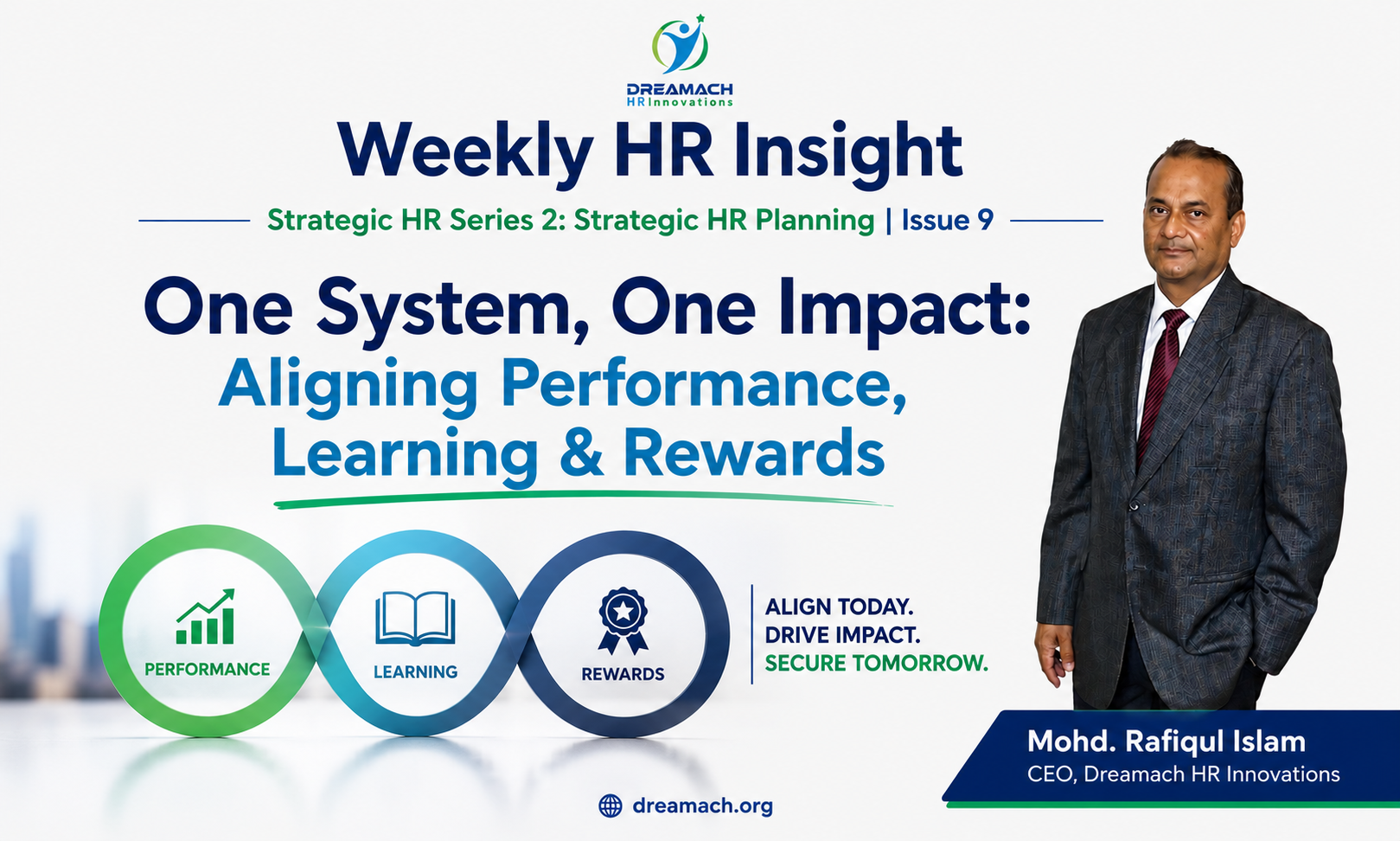
In many organizations, three critical systems operate in silos:
Performance Management, Learning & Development, and Rewards.
Performance is measured annually.
Training is delivered separately.
Rewards are decided based on ratings—often disconnected from real impact.
The result?
- High performers feel undervalued
- Learning does not translate into performance
- Rewards fail to drive the right behaviors
The issue is not the systems—it is the lack of alignment.
The real question is:
Are your HR systems working together—or pulling in different directions?
Pillar 1: From Activity Metrics to Business Outcomes
Performance systems often focus on tasks, not impact.
Traditional HR: Measure activities in isolation
Strategic HR: Link performance to business outcomes
Shift:
From measuring effort → measuring impact
Because what gets measured drives behavior.
Pillar 2: Connecting Learning to Real Performance Gaps
Learning is often planned without understanding where performance is breaking down.
Common reality:
Training happens, but performance stays the same.
Strategic approach:
- Use performance data to identify capability gaps
- Build targeted learning interventions
- Track improvement post-learning
Shift:
From generic training → problem-solving development
Pillar 3: Rewarding Value, not just Ratings
Many reward systems are structured around ratings, not real contribution.
Traditional Model: Equal increments based on grades
Strategic Model: Differentiated rewards based on impact
Shift:
From fairness-driven rewards → impact-driven rewards
Because rewarding everyone similarly weakens performance culture.
Pillar 4: Integrating into a Single Talent Engine
The real value emerges when all three systems operate as one.
Strategic HR ensures:
- Performance highlights what matters
- Learning builds what is missing
- Rewards reinforce what works
Shift:
From disconnected processes → unified execution system
Because alignment turns HR into a business driver—not a support function.
Case Insight (Bangladesh Context)
A leading manufacturing company in Bangladesh faced stagnant productivity despite high - performance ratings.
HR had:
- Strong appraisal systems
- Regular training programs
- Structured compensation policies
Yet:
• Output did not improve
• Skill gaps remained
• Top performers felt disengaged
The root cause: systems were running—but not connected.
After a strategic shift:
- Performance KPIs were redefined to focus on output
- Training was linked directly to identified gaps
- Rewards were tied to measurable contribution
Within a year:
- Productivity increased
- Skill gaps reduced
- High performers became more engaged
Lesson:
Alignment—not activity—drives results.
Management Tip
After every performance review, ask:
What specific capability gap was identified—and how will it be developed and rewarded?
Leadership Question
Are your performance, learning, and reward systems reinforcing each other—or contradicting each other?
Closing Thought
Organizations don’t fail due to lack of systems.
They fail due to lack of alignment between them.
When performance, learning, and rewards work as one system, execution becomes sharper, faster, and more consistent.
Because strategy is not just about direction— it is about reinforcing the right actions every day.
Read. Apply. Transform.
Are your systems aligned to drive performance—or just operating independently?
References
- Kaplan, R.S. & Norton, D.P. (1992). The Balanced Scorecard
- Armstrong, M. (2014). Armstrong’s Handbook of Performance Management
- Boudreau, J.W. & Ramstad, P.M. (2007). Beyond HR

Comments
No comments yet. Be the first to comment!
Add Comment